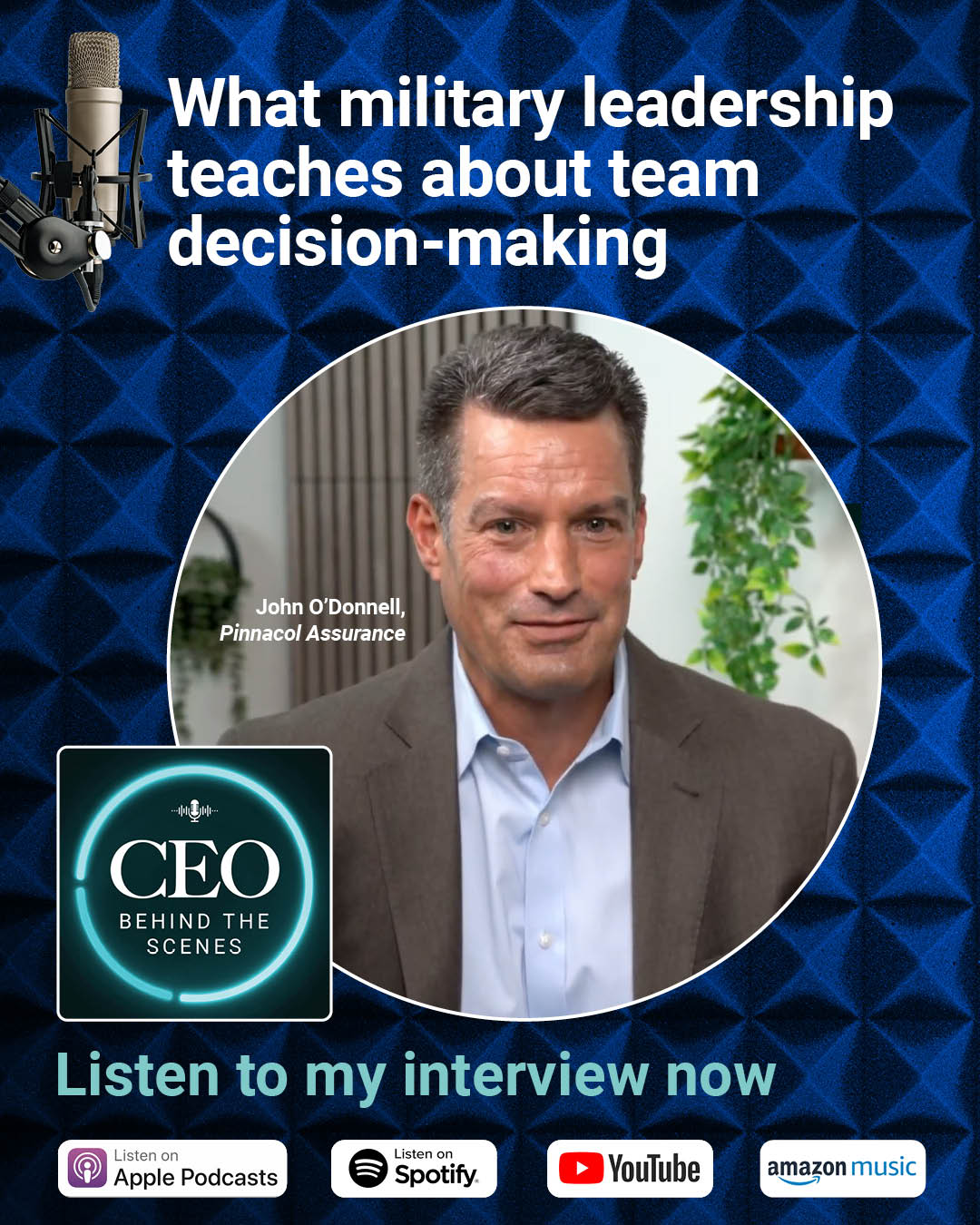
[00:00] John O’Donnell: It's really about teamwork. So we have many partners in the community and key stakeholders. It's it's very important that we're all aligned and rowing in the same direction. Many times I have had my team convince me that I'm wrong about something and and I encourage them to try and convince me if they think I'm wrong. As a leader, you don't need to have all the answers. You don't need to be the smartest person in the room. In fact, you should. You should go on with the assumption that you're, by far, the, not the smartest person in the room. They have a lot of decision making empowerment along the way, and I think that's one thing that's common between my background in the military and in the corporate world.
[00:44] Lara Necessian: Welcome back to CEO behind the scenes. I'm Lara necession, and today we're looking at leadership through a unique lens, one that spans from combat missions through to corporate boardrooms. My guest is John O'Donnell, CEO of Pinnacle assurance, before stepping into the world of business, John flew attack helicopters in the military. Today, he leads a 110 year old company serving more than 50,000 clients across Colorado from building resilience and innovation into a legacy business to investing in young talent through apprenticeship programs. John's story is about leading with both discipline and heart. John, welcome to the show.
John O’Donnell: Thanks, Laura. I'm so looking forward to having this conversation with you, and where I really wanted to start is your own career journey before insurance, you flew attack helicopters in the military.
[01:52] Lara Necessian: What lessons did you extract from that experience that still guide you in your leadership and position as CEO today.
[02:02] John O’Donnell: That's correct. That's how I started my career. Well before I was in the business world, I flew Cobra helicopters, which is the Marine Corps attack helicopter platform for around I was in for just over eight years. You know, I do think a lot of what you learn in the military is transferable to the civilian sector and into the business world in particular. You know, what I would say is the whole idea of you work as a team, I think is really critical. You know, they there were only two pilots in our helicopter, but it took a large team to maintain the helicopter, get us up in the air, to fly the missions, to plan the missions, and without that team, we wouldn't have accomplished very much at all. So you know, I realized that very early on that you just don't accomplish anything just by yourself. And once I entered the business world, I kind of took that with me, and I try and be as collaborative as I can with my team and across the organization.
[03:14] Lara Necessian: And how did you make that transition from being in the military to then entering the corporate world. What was that experience like for you?
[03:25] John O’Donnell: It actually wasn't as difficult. So I had the opportunity to go to business school in between. So, so that was a way to, you know, learn, learn some business skills before I entered that world. And then, you know, I think, like many people, I had to just find my way and learn from others. I talked to a lot of people. I networked, I tried to understand what I was getting into. I learned I didn't have to call everyone sir or ma'am. You know, it was just a different culture. And I thought people were very helpful along the way, and, you know, sharing the different customs once you get out of the military. Because I, I know that can be challenging for people. It's, it's a whole different language with different acronyms in the in the military world versus the business world. But I, again, I think leaning on others to help support that transition was extremely helpful.
[04:24] Lara Necessian: And I'm wondering, how did you translate military level, decisiveness and resilience into leading what is now a people first business?
[04:39] John O’Donnell: Yeah, I think you know there. There are a few things from the military that that sort of come to mind, as you mentioned that. The first thing is, you've, you've heard the term Fog of War where you know you can, you can plan, but the plan never really happens as designed. There's, there's. Always things that change after you make the plan, and you have to adapt. And so, you know, one, one of the things that I would always share when mission planning in the military was what was called Commander's Intent, we would always say, you know, this is the plan, and this is how we want to accomplish it, but at the end of the day, this is really what we're trying to accomplish, and that was really important, because I think there's sometimes a misperception that military leadership is very much top down, and people at different levels are only taking direct orders. But that's not really true, because oftentimes on the battlefield, things become very decentralized, and plans change. So so people have to be equipped to make decisions and to take decisive actions on their own, and so a lot of the training is geared towards making sure leaders at all levels are able to do that with with their teams in the military, and we do something very similar at Pinnacle, where people understand the mission very clearly, but it's there's a lot of autonomy and they understand and they have a lot of decision making empowerment along the way. And I think that's one thing that's common between my background in the military and in the corporate world,
[06:23] Lara Necessian: That's such a great analysis of how you can really translate those skills, because I think a lot of the time, leaders find it difficult to have their teams connect with the bigger picture and the bigger vision. But having that type of an approach is like you're really collaborating to an extent. You're actually inviting that feedback from your team members and then using that to also help guide decisions and strategy and so forth. So it becomes this two way communication. So I love your your taken perspective on that. I want to talk about pinnacle, because it's been around for over 110 years, which is remarkable in any industry. What do you believe has allowed for the company, not just to survive through such an extended period of time, but to adapt through so many shifts in market pressures and workforce expectations,
[07:25] John O’Donnell: I think it's that we have a very clear and straightforward mission, which is to provide caring protection for employees and their workers in Colorado, and that's always our North Star. So you know, when things shift and markets change and there are different pressures and competitors, we always go back to that. And we know that first and foremost, we need to make sure we're there to protect the businesses provide great service and also protect and care for workers if they do get hurt on the job site, and then, of course, to do everything we can to partner with these employers to make the job site safer so people don't get hurt in the first place. So we really lean in to those efforts, and that served us well and allowed us to provide best in class service and care for injured workers over over that over a century long.
[08:31] Lara Necessian: It's quite incredible to have that degree of longevity. What does it feel like to be leading a business that has been around for so many years. How does it feel to navigate all of those different shifts? And you mentioned you've got your North Star, but there's a lot of change and disruption that happens just from marketplace perspective, from external factors, economy forces, etc. How have you really been able to maintain that clear focus despite there being so many potential distractions?
[09:13] John O’Donnell: It's a great question. So I think it's really important to understand who we are, how we differentiate ourselves. You know, we focus on, we use data a lot. So we we focus on various feedback loops. One is asking how we're doing to those who we, you know, commit to provide these services. So, for example, our net promoter score, we look at that closely. That's more than double the industry level. So we focus on that people have different incentives around that same thing. For care of injured workers, our injured worker satisfaction score is the highest by a wide margin in the state of Colorado, and it's been that way for. Quite some time. So you know, we again, make sure that we focus on the things that really matter and get that feedback. Now you're right to mention that there are many dynamics and things are constantly changing. So while we focus on those metrics, we understand sometimes that the tactics to be successful have to be adjusted from time to time. What what got us here won't necessarily get us there. So we're constantly also trying to look around the corner and anticipate how we need to evolve to meet the needs of the employers and employees that we serve,
[10:40] Lara Necessian: And speaking about that future landscape and looking at what's happening tomorrow, things like Al, digital transformation, evolving customer expectations, how is pinnacle, leveraging its legacy while still pushing to stay at the forefront of innovation.
[11:01] John O’Donnell: One thing that we're doing is we're investing in our people and doing what we can to upskill our people. So when Al tools became available, I know some companies were building solutions in the back rooms with the tech team, and then they would roll it out to everybody we we invested in licenses for everybody for an Al platform so that they could become familiar with and it was almost like an organic grassroots campaign to come up with new and innovative ways to serve our members. And it's amazing how creative people were in using those tools to come up with prototypes that then became mainstream tools that the whole organization could use. So really leveraging, you know, training people and then they would come up with the innovative ideas has has really helped us evolve during this time.
[11:57] Lara Necessian: Absolutely Pinnacle serves 50,000 clients across Colorado. How have you maintained a people driven culture at that scale?
[12:11] John O’Donnell: Yeah, it's, I think that's really important. So it's not and it's not only about 50,000 employers, but but those employers employ close to a million workers in Colorado. So you know when, when any of them gets injured? You know, we realize that's a very significant responsibility that we have. We're basically as an insurance company. We're selling a promise to care for them and make them well when they get injured. And I would say what we've done is created a very purpose driven organization. So, you know, I tend to be drawn to those. The Marine Corps was an example, and then Disney was another example. And pinnacle is no different. It just just a different mission. People really that work at Pinnacle really buy into the idea that it's, it's a critical moment for these workers when they're facing one of the worst moments they've ever had, depending or potentially the family, if, unfortunately, there's, there's a fatality on the job, and where who they turn to To start to put the pieces back together and hopefully get them healthy enough to be back to work soon, as soon as possible,
[13:27] Lara Necessian: And speaking about supporting workers and communities at its core pinnacle, provides workers compensation insurance. But how do you go beyond? And you may have just touched on this a little bit, but going beyond the financial product to truly support injured workers.
[13:46] John O’Donnell: Yeah, we do a number of things. You know, we have by far the largest investment in safety programs in the state of Colorado. So with with every policy, we offer a free safety inspection to make sure that injuries are minimized in the first place, and we have a large team that supports that effort, and they're experts at what they do, and so that's helpful, and we've seen that generate results over the last decade. We've seen our injuries or illnesses on the job go down by about 20% so you know that that seems in the collaboration with the employer seems to be working there. We also invest a lot in different grants for workforce development to make sure that employees are or prospective employers are getting the right training. We we also have a foundation supported by the company called the pinnacle Foundation, and what that does is it provides scholarship opportunities for any child of an injured worker or somebody who is killed on the job site they. And regardless of whether they are a pinnacle customer or not, they can qualify for one of our scholarships. And we've sent many students to college on those scholarships.
[15:12] Lara Necessian: That's fantastic. And I I want to touch on that a little bit more actually, because one of the things that really did stand out for me as I was doing my research for this interview was about your commitment to investing in future workforce, and your apprenticeship program for 16 to 17 year olds is something that really stood out. It's been nationally recognized. Why did you decide to invest in the future workforce at such an early stage,
[15:43] John O’Donnell: So about a decade ago. So I have to, I have to give credit to my predecessor for this. There was a delegation that went to Switzerland and studied their apprenticeship program. They have about 70% of their youth participate in these and it's a very viable path for them to get training. And so they took some of those concepts back, and at that time, Pinnacle made the decision to implement a program of our own. It, you know, it challenges some paradigms, because there are most of the jobs in our corporation, in the job description, it required that people had college degrees, and so we had to challenge that and say, is that really necessary if people are getting job training very early on, and when I say early on, We're partnering with high schools so children who are students who are as young as 15, 1617, years old, start our program, and they get classroom training, and then they get on the job training, and it's worked extremely well. It not only helps them develop the skills in any number of functions, such as technology or finance or underwriting claims across the organization, but it also helps some of our team members get leadership opportunities, because they are guiding and training and managing these youth apprentices, and oftentimes it's their first opportunity To be a leader and then sends them onto a management opportunity where they can get promoted. So it's really worked well for our organization, and we feel it's core to our culture.
[17:32] Lara Necessian: That's fantastic. What advice would you give to other executives that are listening and perhaps considering similar investments in young talent.
[17:43] John O’Donnell: The advice I would give is you have to look at the whole picture, right? Because if you're, if you're looking for just a quick return on potentially, you know, call, it a different source of labor. There's some investment, right? And it's going to take a little bit, but if you put the right structure in place, and I think that is key in making sure that you probably have at least one person fully dedicated to this program to oversee it and manage it and make sure that people are getting the right opportunities. I think any company has the opportunity to have it a successful program.
[18:29] Lara Necessian: And something that really stands out to me is the longevity and long term view of everything that you're doing, not just in terms of how long Pinnacle has been around, but even in terms of thinking about these types of programs, there's a long term view. I'm curious how you've been able to cultivate long term perspective and focus on long term success in a world that is full of seeking instant gratification and results?
[19:02] John O’Donnell: That's a, that's a very fair question. So when we when we plan, we'll plan three to five years out. And with many of these programs, you understand that, you know, there's a there's a building towards where you ultimately end up. And so it takes, it takes some patience. It takes constant, you know, investment, and then it takes managing expectations across the organization, with the Board of Directors, any key stakeholders, but, but I find that if you, if you stay with a plan that is well thought out and people are supporting it, it can have great returns. And so, you know, in insurance, we also have an age problem. There are a lot of very tenured people in our field, and we we need the next generation of leaders and and this is helping us get a head start on that absolutely.
[20:00] Lara Necessian: Absolutely. And what role do you believe that companies like yours play in strengthening communities and protecting livelihoods?
[20:10] John O’Donnell: I think it's critical that we're not just looking at the business outcomes. I think it all fits together. We see ourselves as a steward of well being in the community. We are, as I mentioned, we're responsible for almost a million workers if, if they don't have what they need to be safe on the job site and be successful, and if employers that are members don't have the coverage and protection that we provide, and they don't have affordable insurance, then that has an impact on the whole economy and on people's lives and and we take that very seriously, and it's an important responsibility that we carry.
[21:00] Lara Necessian: And something that you touched on was the importance of purpose, and the fact that you've been attracted to purpose led organizations, but you also have a commitment to lead purposeful work. What do you really hope the broader impact of Pinnacle and the work that you're doing with the teams, the apprenticeship programs, like, what is that ultimate impact and purpose that you really wish to to create?
[21:30] John O’Donnell: What I would love to have is a workforce that is safer, is thriving, has lots of opportunity that small businesses can can thrive in Colorado and achieve whatever goals they have. And we want to, we want to be one of their key partners in trying to establish those goals and achieve them. So, you know, we're, we're going to be continuing to work with them and supporting them in any way that we can, and for
[22:02] Lara Necessian: leaders who are listening to this, who want to create a business of impact, longevity, purpose, long term success. What words of advice or wisdom Could you share with them again?
[22:19] John O’Donnell: I'll go back to my first comment about what I learned in the military. It's really about teamwork. So we have many partners in the community and key stakeholders. It's very important that we're all aligned and rowing in the same direction and trying to accomplish the same things collectively and at the same point in time, I also lean very heavily on my team, and I don't just mean my direct reports, but across pinnacle, we work very closely and collaboratively. I do what I can to be approachable and open minded. I many times I have had my team convince me that I'm wrong about something and and I encourage them to try and convince me if they think I'm wrong. And we spend a lot of time together. You mentioned earlier about thinking long term and sort of setting expectations and planning together. Once a month, we carve out a full day as an executive team, where we discuss strategy, we put ourselves in a room, and we're just discussing strategy, and we have other, you know, key people within the organization come in and join in those conversations. And I think that's really important, that everybody thinks as a general manager, they're not encouraged to just stay in your lane depending on what department they work in, but rather think, think like you own the business, and how do we achieve our goals together?
[23:53] Lara Necessian: That's brilliant advice. Thank you for sharing that, John. We wrap up all of our interviews at CEO behind the scenes with the same two signature questions. So the first question I wanted to ask you is, what is one thing that you've changed your mind about recently, and why I'm
[24:13] John O’Donnell: a little more traditional, and I'm sort of came up going to the office every single day, and, you know, being in the office when I'm working and covid changed that a little bit. We had to. And even beforehand, though I was I was pretty open minded about that. So what I would say is, early in my career, I did not necessarily believe organizations could be as effective with a hybrid work environment or a remote work environment. And I've changed my mind on that, you know, we at Pinnacle have given people flexibility to work either at home or in the office or both, and some of its job dependent. And if you have clients you have to see, then you know, you may, you may need to be. Be on site, but for the most part, it's fairly flexible, and I think that really gives us an edge in attracting and retaining talent. And we've checked our productivity numbers and the metrics I was mentioning earlier, and none of those have suffered. In fact, I think in many cases, people might be a little more engaged because they're not having to deal with long and arduous commutes and some of the other things. So it seems to have worked really well for us and I, and I think if you would have asked me a couple of decades ago, I would, I would not have said that
[25:34] Lara Necessian: that's a brilliant and question two, what is one thing that you've not changed your mind about a belief that you'd want to share to help others lead or live better
[25:47] John O’Donnell: as a leader, you don't need to have all the answers. You don't need to be the smartest person in the room. In fact, you should, you should go on with the assumption that you're, by far, the, not the smartest person in the room. I remember. I'll go back to my Marine Corps days when, you know, because I was a pilot, but I also in the Marine Corps, you also lead Marines who have jobs on the ground. And I had the airframes unit which was responsible for making sure the airframes of the aircraft were all ready to go and maintained and replaced as needed. And I walked into the job as a brand new Second Lieutenant the first day, had no experience here, just, you know, flying was my only experience. And then went in and the gunnery sergeant, who was in charge after me, of everybody else, said, okay, sir, so what are we doing today? And I'm like, Okay, I understand what you're telling me, You're in charge. I'm here to support you. You tell me what the plan is, and I'll try and remove barriers. Get you the tools you need, whatever the case might be. And I've and I've tried to, you know, maintain that mindset through the business community, where everybody who works for me knows a lot more about their role than I do, and I'm oftentimes here to again, remove barriers and provide tools and opportunities so things can come together.
[27:12] Lara Necessian: Very well. Said, John, you have shared so much wisdom and insight around your leadership journey around leading with purpose and heart, adapting a legacy business and investing in future talent, this has been such a incredible and broad conversation that we've been able to cover today. Were there any final words, any final messages, or anything that we haven't yet covered that you wish to leave our audience with today?
[27:41] John O’Donnell: You know, I go back to the purpose driven right like I do think that that also gives us an advantage. If people are working in a job where they can connect what they're doing on a daily basis to providing some greater good. I think that gives us a huge edge in both in their engagement and how they serve our members, and how they serve the workers that we serve and they want to stay, and people stay at Pinnacle for a really long time, and I think it's because of the culture we've created and the purpose we serve very well.
[28:19] Lara Necessian: Said John, thank you so much for joining me for this conversation today. It's been such a pleasure and privilege to have this this conversation today, likewise, thanks so much. Larry, thank you so much. And to our listeners, if this conversation sparked ideas, please ensure that you share it with someone who is on their own leadership journey, and who you know would really benefit from hearing John's valuable insights that he has shared with us today, and make sure to subscribe, rate and review the show for more. Thank you so much for joining us, and we'll see you next time on CEO behind the scenes.